
For mentors working with farmers, profitability is not only about production. It is about helping farmers notice the business signals behind their daily decisions: what costs too much, what generates value, and what needs to change before the next season begins.
By Mpumelelo Ncwadi
I am a Nguni livestock farmer, human-scale farmer educator, and agribusiness owner-operator mentor with more than a decade of experience helping farmers think beyond production and build stronger businesses.
My approach is based on a simple premise: Knowing how to grow crops and raise livestock is not the same thing as knowing how to run a business that grows crops and raises livestock.
When mentors support farmers, one of the most valuable shifts they can encourage is from asking, “How do I produce more?” to asking, “How do I make this farming business more profitable and resilient?”
One way I strengthen the profit fitness of my mentees’ businesses is by teaching them three profitability levers drawn from former Zimbabwean agricultural economist Stan Parsons: reduce overhead costs, improve gross margin, and increase turnover.
- Reduce overhead costs, including land and labour costs.
- Improve the gross margin per unit or per hectare
- Increase turnover
Gross margin per unit measures the economic efficiency of cows, goats, sheep, or whatever the farm’s productive units are. The higher the gross margin, the greater the efficiency. A highly productive Boer goat with a strong kidding record may deliver a better gross margin, but one goat will not cover the overhead costs of a farming operation. Farmers need enough well-adapted livestock to match their environment and their business model.
The same principle applies to crops. Expensive equipment and other overheads become harder to justify when the productive units per hectare — kernels of maize, heads of cabbage, or bunches of spinach — do not improve gross margin or increase turnover.
This is what the three levers for making money from farming look like in practice.
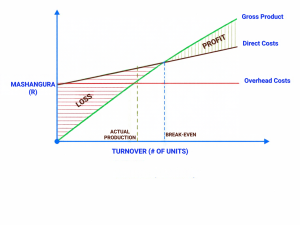
To move from good to great, farmers must understand the difference between working in the business (WITB) and working on the business (WOTB). The farm worker focuses on daily production tasks; the agribusiness owner-operator focuses on the systems, decisions, and strategy that make the business profitable.
Most smallholder farmers do a lot of WITB and very little WOTB. They are very good farm workers. When it comes to driving a tractor, pulling calves, vaccinating cows, or spraying crops, they do a great job. The problem is that they may not be doing the right job to increase the profitability of their farming operations.
That is why mentors must help farmers shift their focus from low-value daily chores, such as R100-per-hour work, to high-value strategic management, such as R1,000-per-hour work.
Preparing farmers for El Niño risk
To build profit fitness for the 2026/27 season, farmers should pay close attention to warnings of a severe El Niño event. For mentors, the message is simple: climate risk must be part of every business conversation before the season begins.
According to Karen Singh, “El Niño is a naturally occurring climate pattern characterised by warmer-than-average sea surface temperatures in the central and eastern Pacific Ocean.” Its effects vary from event to event, but El Niño is historically associated with below-normal summer rainfall, hotter temperatures and drought conditions across much of Southern Africa.
Why this matters for farmers and mentors
According to Paul Makube, senior agricultural economist at FNB Commercial, “El Niño forecast poses a huge risk to summer crops because the weather pattern is associated with erratic, below-normal rainfall and drought in Southern Africa.”
Put simply, El Niño can bring prolonged drought, erratic rainfall, and, in some areas, flooding. Higher temperatures reduce soil moisture, shorten the growing season, and cut crop yields. For farmers, the consequence is stark: less money flowing into their business bank accounts.
Floods often result in the erosion of the fertile topsoil, eroding the farmer’s natural working capital. When this capital is depleted, the result is agronomic bankruptcy for the affected farmers. To safeguard against such shocks, farmers should diversify through mixed operations—combining crops and livestock—rather than relying solely on speciality commodity crops like maize or soybeans.
Mentors can use this moment to ask practical questions: Which costs will rise if rainfall is poor? Which enterprises can survive a dry season? What records will show whether gross margin is improving? What decisions must be made now, before the weather forces them later?
Farmers should always remember that healthy soil is the foundation of productive, sustainable agriculture. To cope with El Niño, they must go beyond conventional farming and actively promote soil health by consistently observing four key soil‑building principles:
- Minimise soil disturbance — reduce tillage to protect soil structure and microbial life.
- Maximise soil cover — keep the soil shielded with crops, residues, or cover plants to prevent erosion and moisture loss.
- Maximise biodiversity — rotate crops and integrate livestock to enrich the soil ecosystem.
- Maintain living roots — ensure that plants grow year‑round to feed soil organisms and stabilise the soil.
Improving soil health is not a magic bullet. But it is by far the best way for farmers to farm for profit. It’s insurance against unexpected weather variations.
Case in point
For the past five years, I have worked with the Grassland 2.0 initiative (www.grasslandag.org) as a Research Assistant and supported undergraduate agroecology classes as a Teaching Assistant. During this time, I worked closely with the community of Mozana Village, Ward 32, Buffalo City Metropolitan Municipality (KuGompo City), in the Eastern Cape.
Local smallholder livestock farmers in Mozana were disadvantaged by networks, institutions, and infrastructure concentrated downstream in the South African beef supply chain. I supported the community with an investment readiness strategy that included formalising governance structures, developing a bankable business plan, improving livestock quality, establishing appropriate animal-handling facilities, and introducing systems for traceability, recordkeeping, and biosecurity.
This work has since been validated by the latest research of the Red Meat Industry Services (RMIS), and the Mozana community is now under consideration for a R1 million seed‑stage grant from Mercedes-Benz SA.
The lesson for mentors is clear: pay attention to the business behind the farming activity. Help farmers read their numbers, protect their soil, prepare for climate shocks, and make decisions that improve profit fitness. Farming smarter begins when farmers stop seeing profitability as an outcome and start managing it as a discipline.
Thank you for reading this article. Fetola regularly writes about small business development, sustainability and circularity, and has a passion for effecting scalable impact at the ecosystem level. To receive updates, please sign up here.


